










Saw Blades for Quarry
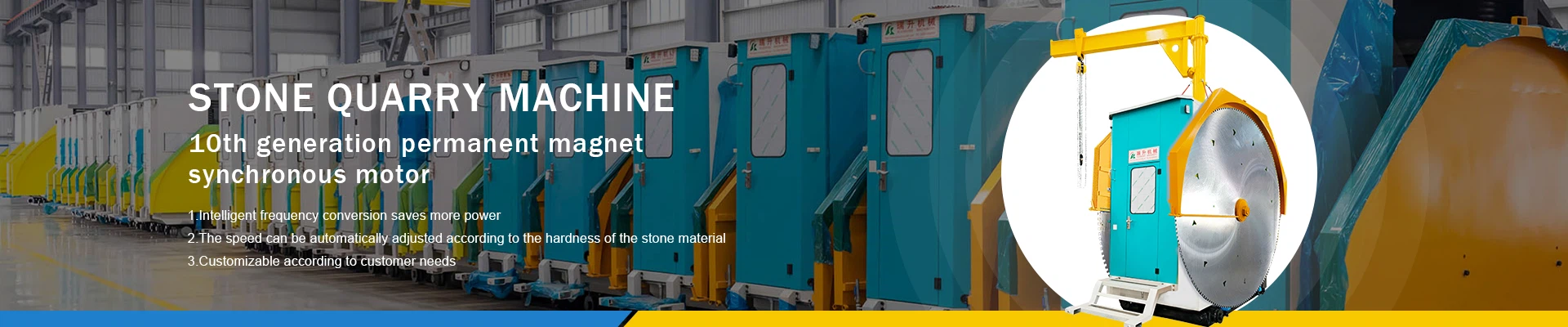
Ruisheng Machinery is a brand under Nan'an Ruilong Machinery Co., Ltd. Ruisheng Machinery has been focusing on stone mining and stone processing equipment in China for many years. We started as a small business but have now become one of the leading suppliers in China's stone industry. Our products include double-blade mining machinery, diamond wire saw machines, block-cutting machines, large plate-cutting machines stone polishing machines, etc.
Why Choose Us?
Rich product range
Our company can manufacture and produce double-edged stone mining machines, diamond wire saw machines, stone mining equipment, stone engraving machines, water jet cutting and more.
Products widely used
Our products can be widely used in granite, marble and other stone mining, as well as block cutting, slate cutting, special-shaped carving, tabletop processing, tombstone stone processing, stone waterjet cutting and other purposes.
Widely sold
The market share of our product double-edged mining equipment exceeds 70%, and the main sales markets of our stone machinery are Central Asia, Southeast Asia, Russia, the Middle East, Africa and other regions.
Leading service
We have many years of industry experience and a complete production management, quality supervision, sales service operation system. Whether you want to buy a diamond wire saw or a stone polishing machine, just send your requirements via email and we can customize the product for you.


Saw blades for quarrying are specialized cutting tools used in the extraction of stone blocks from quarries. These blades are designed to withstand the harsh conditions and demanding requirements of quarrying operations, where large blocks of stone need to be cut efficiently and with precision.
Benefits of Saw Blades for Quarry
Wide Range of Sawing Applications
Circular saw blades consist of steel saw bodies with cermet and carbide-tipped teeth. The tips are then ground to match the application for which the blade is being used. Circular saws have a wide range of sawing applications such as carbon steel, alloy steel, stainless steel, bearing steel, and tool steel.
Low Energy Consumption
Longer life and faster cutting are the main reasons why a shop would switch to circular blades. Carbide-tipped blades start off sharper and remain sharp much longer than steel alternatives because of their great wear and heat resistance. A sharper edge means less chipping and shattering with higher feed rates. You won’t have to change your blade as often, saving you time and money over the long term.
Less Vibration
Circular saw blades generally create less vibration which will lower the noise level ultimately leading to a better surface finish of parts.
Increased Productivity
Generally, they stay sharper for a more extended period. Making that dreaded blade change happen less often allows the saw to stay running and your operator to focus on more important tasks.
Superb Surface Finish For Secondary Applications
Due to the durability and toughness of the blade, the edges can remain sharp for a considerable time. Only a sharp edge is capable of making smooth and clean cuts. The fact that cermet/carbide tips will stay sharp for a significant time will enable you to cut various applications smoothly.
Longer Blade Life
Did you know that circular saw blades can last for thousands of cuts? Not only will you gain an advantage in cut times you also gain time from not changing a blade as often as your competitor. Let them change blades while your production jobs are going out the doors.
Hardened Blade For Repeatable Accuracy
Saw experts say it’s the ability to have fast and repeatable accurate cuts with a great surface finish. These saw blades are tough and capable of pushing through the material effortlessly.
Fits a Wide Variety Of Machines
No matter the manufacturer of your Circular/Cold saw has the blade for it. Our blades fit most manufacturers' machines.

Common Types of Saw Blades
Ripping Blade: For the Smoothest Results
These blades are crafted to return the smoothest, cleanest, and safest cuts when ripping wood. They come with a restricted number of massive, neat teeth. Therefore, casting off the dust from the cut and removing it is a piece of cake.
Crosscutting Blade: For Delicate Cuts Across the Board Face
These blades are designed for making cuts across the board face. They boast more teeth than a ripping blade, as well as smaller gullets. Crosscutting blades take more time to cut, but they return cleaner, more delicate results.
Plywood Blade: Best for Delicate Stuff
It’s all in the name. This type of blade is utilized for working with plywood and similar, highly splinterable materials. Usually, plywood blades come with a lot more teeth than the aforementioned types. As a result, they produce fine cuts and prevent wood tearing.
General-Purpose Blade
If you don’t always have time to change blades, this versatile blade type is for you. Furthermore, general-purpose blades also referred to as combination blades, are definitely right up your street if you work on a multitude of various woodworking projects.
Finishing Blade: When Ultra-Smoothness Is Prioritized
This type is your best bet. Basically, it’s for performing the cleanest cuts on sections of wood that will be clearly seen once you’re through.
Thin Kerf Blade: Less Waste & Less Dust
Kerf is represented by the width of the cut. Thin kerf blades make particularly narrow cuts and are most frequently utilized for working with dimensional lumber. This blade comes with skinny teeth, which means less wasted wood and less sawdust.
Paneling Blade: For Panels, Veneer, Plywood
This blade is usually utilized with a radial arm saw or a table saw. Some tradesmen even cut plastic with it.
Masonry Blade: It’s Toothless
Indeed, this type comes with no teeth. If you work with masonry of any sort, this is the only type of blade that will suit you like a glove.

General-purpose blades are designed to make all types of cuts, including in plywood, laminated wood, and melamine.) What a blade does best is determined, in part, by the number of teeth, the size of the gullet, the tooth configuration, and the hook angle (angle of the tooth).
Number Of Teeth
In general, blades with more teeth yield a smoother cut, and blades with fewer teeth remove material faster. A crosscut blade, on the other hand, is designed to produce a smooth cut across the grain of the wood, without splintering or tearing. This type of blade will usually have 60 to 80 teeth, and the higher tooth count means that each tooth has to remove less material.
Gullet
The gullet is the space in front of each tooth to allow for chip removal. In a ripping operation, the feed rate is faster and the chip size is bigger, so the gullet needs to be deep enough for the large amount of material it has to handle. In a crosscutting blade, the chips are smaller and fewer per tooth, so the gullet is much smaller.
Blade Tooth Configuration
The shape of the saw blade tooth and the way the teeth are grouped also affect the way the blade cuts. The configuration of the teeth on a saw blade has a lot to do with whether the blade will work best for ripping, crosscutting, or laminates.
Flat-Top (FT)
Flat-top teeth are used on blades for ripping hard and soft woods. Because wood is much less likely to chip and splinter when it is being cut with the grain, a rip blade is designed to quickly and efficiently remove material. The flat-top tooth is the most efficient design for cutting and raking material out of the cut.
Alternate Top Bevel (ATB)
This means that the blade teeth alternate between a right- and left-hand bevel. This configuration yields a smoother cut when crosscutting natural woods and veneered plywood. The alternating beveled teeth form a knife-like edge on either side of the blade and make a cleaner cut than flat-top teeth.
Combination Tooth (Comb)
Combination blades are designed to do both crosscutting and ripping. The teeth are arranged in groups of five – four ATB teeth and one FT – with a large gullet between the groups.
How To Change The Saw Blade On a Circular Saw?
● Locate the arbor nut, positioned in the center of the blade, which secures it to the saw. If your circular saw is equipped with a locking button, engage it to immobilize the blade while loosening the arbor nut.
● Using an appropriate wrench or tool, carefully loosen and remove the arbor nut. Take care to avoid damaging the blade or other components during this process.
● Once the arbor nut is removed, gently slide the existing circular blade out of the saw, making note of its orientation for future reference. At this point, you may choose to either sharpen the blade or replace it entirely, depending on its condition.
● When inserting a new blade or reattaching the sharpened one, ensure it aligns with the saw's arbor. Slide the blade into place, ensuring it fits securely within the arbor assembly.
● Finally, reattach the arbor nut and tighten it firmly using the appropriate wrench or tool. This step is crucial for maintaining a secure and stable connection between the blade and the saw, preventing any potential accidents.
Installation requirements of Saw Blade
● The equipment is in good condition, the spindle is not deformed, and the installation is firm and fixed.
● Check whether the saw blade is damaged, and check the tooth shape and saw plate.
● The arrow direction on the saw blade should be consistent with the rotation direction of the equipment spindle.
● When installing the saw blade, keep the axis, chuck and flange clean. The inner diameter of the flange should be consistent with the inner diameter of the saw blade.
● Before starting the equipment, to ensure safety, please allow the saw blade to idle for a few minutes after installation. If there is no slipping, swinging or jumping, and then allow the saw blade to operate normally.
Keep the cutting area clear of metal chips
Keeping the cutting area clean will prevent stray chips from running through the kerf during the cut. Having a properly adjusted chip brush is also critical in cleaning chips from your saw. Make sure the brush just "kisses" the teeth of the saw blade.
Make sure all fluids are fresh and at the proper level
Having fresh coolant with the proper mixture will extend the life of your saw blade. Check to make sure that coolant has the proper flow. Changing the gearbox oil on a regular basis will give you a smoother cut. Don't forget to check the hydraulic oil level often. This will extend not only the life of the blade, but the life of the saw.
Check that the guides and the blade are properly aligned
All blade guides must be able to operate freely and have proper alignment and adjustment in order to obtain top performance. Proper alignment of the saw's blade track is critical. Wheels that are not in alignment can damage blades by riding low on one wheel and tight against the lip of the other. Improper tracking can cause swagging of the edge and popping of the saw blade off the wheels. If this happens the blade will have a camber and will be very difficult to track in the future.
Perform operation checks and test the machine set up regularly
Having a machine that is set up properly is the best way to maintain smooth operation of your saw and saw blade. Correct operation of the machine will provide less maintenance problems, higher cutting capacity, and will extend the overall life of your machine tool.
Our Factory


FAQ